Natural Connection
Main Menu
What is Natural Connection?
What is exciting about Natural Connection
Foundations of the Natural Connection
Full movie — The Natural Connection – the natural bond
Uri Peleg – Part 4/4 – Natural Connection
The Natural Connection – Road to Natural Connection Series
A Diagram That Taught Me the Structural Similarity Between the Horse and the Human as a Basis for Natural Connection
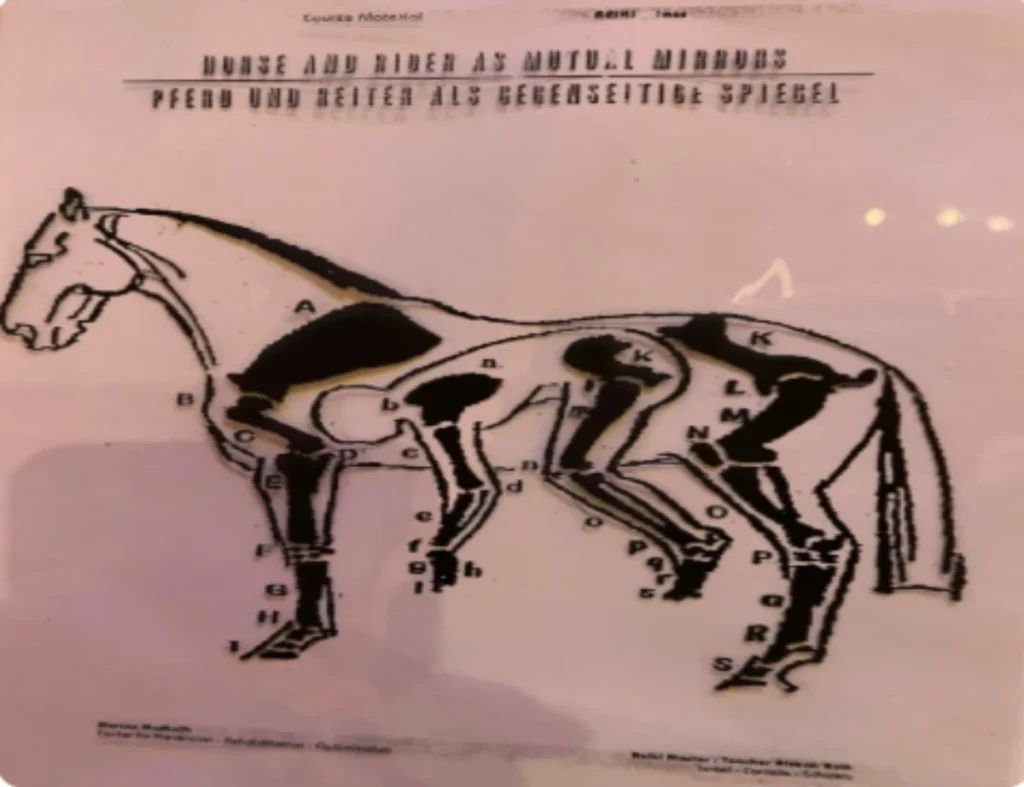
Ahead of the upcoming videos, some of which will deal with how we create a steering style that is characteristic and suitable for trail riding—as opposed to the steering commonly used in the competitive world—I am presenting here a diagram that has taught me a great deal about horses and their response to the points we press on different parts of their body in order to receive a desired reaction, in steering for example.
The steering I propose is steering with direct rein pulls, and consequently also the placement of the legs in positions different from those commonly used in the Western or English worlds, which will cause the horse to move its shoulders following its head in a turn or side movement, to the right or to the left. And this through our hands and our legs. (I will show this in the upcoming videos.)
This steering will solve countless problems that arise from steering using “neck reining” on the trail, in all its forms—a technique that is characteristic of and copied from the competitive riding arena.
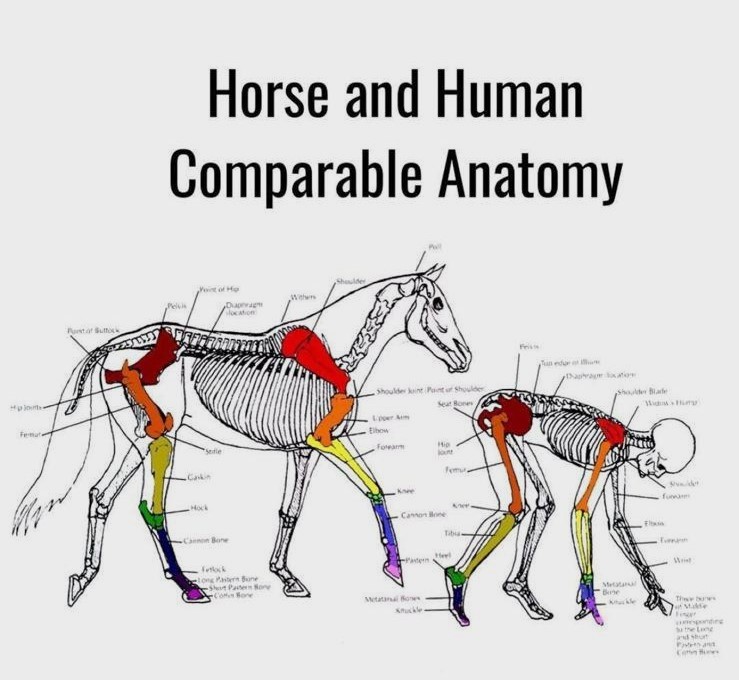
As preparation for the next videos, I am publishing here a diagram of a human skeleton inside a horse, which has taught me so much about the absolute similarity between the horse’s responses to pressure points on its body and our own responses to identical pressure points on our bodies.
Hand and Leg Position While Riding in Natural Connection
Friends, this is Uri Peleg — www.uripeleg.org.
This is a somewhat longer video that takes a closer look at the riding position, with very important recommendations about riding with two hands and using a leg position that is suitable for trail riders, as opposed to competitive riders — English and Western riders.
Arena riders are bound by the traditions of English and Western riding, and they are required to follow them according to the rules of competition.
Remember — we have no reason to use those traditions. We need a different hand and leg position.
We are free from traditions. We do not need to hold the reins in one hand — not in order to free one hand to catch calves, not to shoot Indians, and not to behead infidels.
We need to ride in the safest way for us, and in the clearest way for the horse.
Let go of the traditions that dictate these techniques, which are demonstrated in the competitive world, both in English and Western riding.
These techniques “do not hold water.” In other words, they will not stop a frightened horse, they will not force him to turn exactly where we intended, and they will not prevent refusal, rearing, bolting, and so on.
Please listen carefully…
Recommended Way to Hold the Reins for Trail Riders — Without Needing to Shorten or Lengthen the Reins During the Ride
Hello, this is Uri Peleg — www.uripeleg.org.
In my opinion, this is the best way to hold the reins during trail riding.
There is no longer any need to shorten or lengthen the reins.
You can ride for an hour or half a day with your hands in exactly the same place on the reins, and you can stop, release, turn, collect, and do everything without changing the length of the reins.
recommended and correct Two-Handed reins Control , vs. One-Hand Stop, In stressful situations
Human and Horse Diagram
Using the Natural Connection technique to prevent resistance to forward movement
# In natural connection. ) Using the natural structure of the horse to create a situation in which he will not be able # to resist what is requested, not to kick and not to bite.. uri peleg 972-50-6914939 @… enjoy
Using the Natural Connection technique for effective steering of a horse that is drawn to the herd
Hello everyone, the following video is about using Natural Connection (consideration of the natural structure of the horse) for more accurate execution of steering of the shoulders, compared to neck reining for example.. for a trail-riding lesson with me; Uri Peleg 050-6914939
Riding with the Natural Connection technique to correct the horse’s movement when he takes us wherever he wants with his shoulders
Today’s video demonstrates riding a horse that refuses to move with his shoulders after his head.
Pay attention to the rein hold, the steering, the control of the horse’s shoulders, and the pelvis positions — deep seat (a deep, anchoring seat), retarding seat (a delaying seat), and driving seat (a pushing seat).Thanks to Noam who filmed.
For riding lessons and trail-riding lessons, for private courses in training, communication, and riding, and for private courses for trail-riding guides,
call me 050-6914939
Warms the heart, until minute 2:09 — suddenly I see her focusing her gaze behind me, and within a second I understood… enjoy.
Using the Natural Connection technique to overcome a mare’s refusal to leave the pen
And today, about taking a mare that refuses to go out to the field from the pen (and actually when facing any obstacle..).
The technique — control of the shoulders..And the order is:
When the mare refuses to move,
head and shoulders to the right, and movement to the right, and immediately afterward to the left, and movement to the left..
and so on again and again.
After several times, directing the mare straight forward, toward the obstacle, and releasing the reins with urging from behind.
Thanks to Noam who filmed.
Using and positioning the spurs in Natural Connection.
And today an important video about spurs.
An important aid for the precision of the cue.. spurs have a stigma of violence that comes from incorrect use.
Only through constant use can one achieve gentleness in use — and correct use.
It is recommended to work with the timing of the tip of the spur in synchronization with the lifting of the hind legs.
With correct use — it is a highly valuable guidance tool.
To reach precision, refinement, and correct use, it is advisable not to remove them from the riding boot so as to practice and get used to them constantly.
With sensitive horses, they are not used (without removing them from the boot), and if necessary the calves are brought closer instead.
Learning to use a spur without using it regularly is like learning to swim by correspondence.
For my students — exercise 3 is recommended in order to acquire the skill on this subject. (It also puts the legs in the right place and also teaches timing with the spur.)
It is recommended to use Western spurs from which the rowel has been removed, so as to use a larger contact surface of the spur.
The length of the spur neck is proportional to the distance of the heels from the horse’s belly;
tall people usually need spurs with a longer neck, and vice versa.
When replacing spurs — try to replace them with the spur neck of the same length, so you won’t need to “get used again” to the distance between the spur and the horse’s belly.
Thanks to Hezi “the Pole” who filmed..
Using Natural Connection to cross a mud obstacle
Today I will talk about rein holding and the horse’s steering in trail riding.
In the attached video you will see the form of holding and action of the hands and legs in a simple crossing of a muddy puddle, which the young filly hesitated to cross under me.
Yes, all of us in the field like to hold the reins in the palm, with one hand… (Personally I hold with two hands, and for years I haven’t allowed myself the privilege of neck reining—steering by pushing the rein on the horse’s neck with one-hand rein holding…)
But I see most trail riders using steering and the palm…
And it’s clear to me that even this article will not change most of you, but if I helped at least one or two get out of a problem—it was worth writing about it..
So a few points worth paying attention to in extreme cases…
Neck-reining came from hundreds/thousands of years ago, when the warrior had to fight with his sword, and guide the horse with neck-reining from the other hand..
In modern times, riders threw a lasso or dragged something in ranch work— and the other hand guided the horse with neck-reining.
In almost all competitive riding disciplines there is neck-reining that is important for judging on appearance.
Neck-reining will remain forever in trail riding as a suggestion— and direct rein as a requirement.
Neck-reining is done most of the time with one hand (and sometimes two).
See the amazing spins that are executed with neck-reining—in reining and in other disciplines, only from a touch of the opposite rein on the neck…
Neck-reining exists also in pleasure, all-around, and trail class in the arena, and of course also in extreme cowboy race, and obviously in most cattle disciplines like roping, cutting, penning, etc’.
Of course there is also in dressage the use of neck-reining for steering; only there it is called the supporting outside rein (sport rein).
So if it looks nice, and “cool”, what’s the problem with one-handed holding in trail riding and using neck-reining?
Because for us, the trail riders (appearance isn’t very important…), efficiency is what matters. And neck-reining does not solve the problem—only amplifies it…
Crossing a scary obstacle in the field, pulling a horse out of a group that “flows in one direction”, overcoming fears from changing factors—shadow, animals, a rolling thorn, passing vehicle or bicycle or ATV… dynamic and constantly changing terrain, without pause; add to it mud, water, slopes and rocky climbs… and—whatever you want…
It is possible with many techniques, but neck-reining in my opinion will not give a solution.
I recommend using the technique I will suggest here…
The suggestion for neck-reining will not be accepted by most horses, for example, if we want to turn a horse of a medium training level toward the opposite direction of the fast-moving group of horses riding with us toward some direction… (And certainly toward the barn…)
Suppose you want to pull a horse out of a group of riders, somewhere in the field, toward the trailers or the barn.., and your wallet fell, or you must pee, or the hat fell, or your paths split: the group to one direction, and you to the opposite…
In most cases, you have no chance of pulling your horse alone, with one-hand steering and neck-reining, toward the desired direction.
And what will we do when the said horse will inform us: I’m not going through here! — and will brake sharply and try to rear if we still force him to move forward while we hold with one hand and use neck-reining? — High chance the next stage will be “rearing—getting up on two legs”…
Steering with a direct pull and releasing the opposite hand is meant to direct the horse’s head,
but it is worth nothing (!!!) if we do not direct the shoulders after the head…
And if you do that — the horse will “bend” and will not stay straight in front of the obstacle.. and then his capability to rise up (rearing) disappears. And also his resistance.
This is the key to the whole proposed technique.
It will be done by pressing the right leg on the center of the barrel (ribcage) in a right turn, together with the left leg in the girth area, while mechanically pulling the horse’s head to the right and releasing the outside rein to the mane..
The order will be:
Leg (on the ribcage, to bend the horse) — right hand takes the right rein and therefore the horse’s head to the right (so that both body and head bend right), left hand to the mane without (!) neck-reining (to completely release the horse’s head so he can tilt it right without interference..) — and left leg in the front girth area (to push the shoulders right after the head..)
And all of it: leg, hand, hand, leg…
(So why not add neck-reining to this— I will explain in the next videos…)
Enjoy watching.
For questions, workshop bookings and training courses for you together with your horse, and also for Natural Connection (whose foundations are written above..),
Uri, 050-6914939
Demonstration of the natural connection abilities with body language only
Using collection for reverse
And this time, about the importance of collection when we come to lead the horse backward. Notice that the collection, whose outcome is shifting weight backward, is possible only thanks to the lifting of the horse’s back, which “makes room” and allows the neck to arch and the horse’s pelvis to come under the horse, provided there is movement. Be considerate of your horses, and try to create collection in order to achieve better backward movement, more comfortable for the horse.
Uri Peleg – private workshops for riding in trail riding, 050-6914939Dealing with fears of objects and water
This time the video shows the dealing with the fear of a young mare from a cardboard box on the floor and from an absolute refusal to enter a puddle of water. In the morning a very skilled rider rode her and tried to direct her with neck reining toward the puddle, and to urge her so that she would go in..
The mare, in response to one of the attempts – lifted up to a height of 20–30 cm.. which could have led to a full rear up on two legs (rearing) and greatly endanger the rider.
Pay attention to the Natural Connection technique that I use: pushing the ribcage and pushing the shoulders after the horse’s head, this way I “bend” the horse…
A bent horse won’t rise, said one of my students… Come learn private courses with me:
Uri Peleg. 050-6914939
