Hello everyone, so how are we actually supposed to ride?
Today I want to write to you about five central and important parameters for every rider. It doesn’t matter if the rider is on a horse of one breed or another, in Western style or Dressage, in the arena or out on the trail.
These five parameters bring us to a situation where we can function and ride without resistance and with relatively refined cues, which will be received more easily and without objection from the horses.
The first parameter: Movement (of the rider) with the movement (of the saddle).
This parameter is especially important in jog/trot and in canter, to prevent the horse from suffering from the rider’s bouncing on its back, and to prevent the rider’s loss of balance.
(Recently, gaited horses – the walkers – have become very common. Riders on them mainly ride at a fast walk, therefore they are exempt from this need in jog/trot that doesn’t exist, but they must use it in the lope/canter.)
This is not about the posting trot (rising trot), which also helps but exhausts the rider over time and is problematic on horses with a medium or lower level of training, since most of the time the rider is in the air and not close to the horse.
The second parameter: Straight lines.
The straight lines prevent unintended pulling and allow greater sensitivity in the fingers/hands to feel the horse’s mouth.
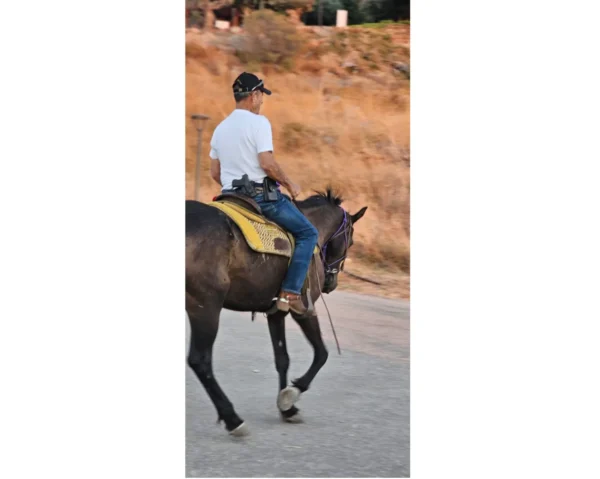
The well-known line—ears–shoulders–hips–heels—will protect the horse’s back and its ability to perform without pain and with greater comfort.
The lesser-known but equally important line—elbows–fists–the horse’s mouth—will allow us to feel better (both with constant rein contact and with loose rein contact) during a pull, what is happening at the other end, at the bit, and will prevent—if the rider and horse are at an elementary level—unnecessary discomfort and the horse opening its mouth in protest.
The third parameter: Ability to drive the horse forward.
This refers to the rider’s ability to transmit, through seat aids, an invitation to the horse to move.
The fourth parameter: Awareness of the horse on the bit.
In the narrow sense, it refers to our ability to place the horse’s head where we request.
In the broader sense, to our ability to collect the entire horse to improve its performance.
The fifth parameter: Awareness of the lead.
This refers to our ability to recognize and choose the leading leg in lope/canter/gallop that will suit our needs according to what is required in the arena or on the trail.
If we ride with awareness, attention, and execution of these parameters, we will make things easier for ourselves and for the horse, and our riding will be much more enjoyable and safe.
Uri Peleg